The Number Of ADA Certified Portable Restrooms Are Required in a Rental Collection?
If you are leasing portable bathrooms for an event, event, public event, or temporary site configuration, the short response is this: when you have a collection of portable single-user bathroom systems, a minimum of 5 percent of the devices in that collection need to be accessible.
That is the number most people are searching for when they inquire about an ada mobile bathroom or an ada certified portable toilet. But in technique, the matter is only part of the task. The accessible unit has to be an actual, useful holiday accommodation, not just a bigger box went down somewhere on the edge of the lot.
That distinction matters. I have actually seen organizers concentrate on purchasing the ideal amount of ada compliant mobile toilets, after that overlook whether someone can really reach the unit, make it through the entry, turn inside, and make use of the fixture with the called for clearances. Compliance is not just a math issue. It is a placement and usability issue too.
The number that controls the cluster
For mobile single-user toilet units set up in a collection, the controling availability rule is that at least 5 percent of the units in each collection should be accessible. The Access Board has actually explained that this applies even at short-lived events.
That suggests the need is tied to the collection itself, not just the site overall in some unclear sense. If you have one bank of systems near the primary entry and another financial institution near food solution or a distant activity location, the question is not only how many complete devices you rented for the day. The question is how many are in each cluster and whether each collection consists of the needed accessible share.
This is where individuals occasionally obtain tripped up. They assume one ada easily accessible portable washroom someplace on the residential or commercial property cares for every little thing. The availability requirements are much more specific than that. The 5 percent guideline applies to collections of portable single-user devices, and the available units need to belong to that setup.
If you are using the expression ada-compliant mobile bathrooms in a rental conversation, this is usually the https://pristineportablesil.com/service-area-east-moline-il/ very first indicate pin down with your supplier. Ask the amount of devices remain in each cluster, the amount of available devices are being provided within each one, and where they will be placed.
Why the matter alone is not enough
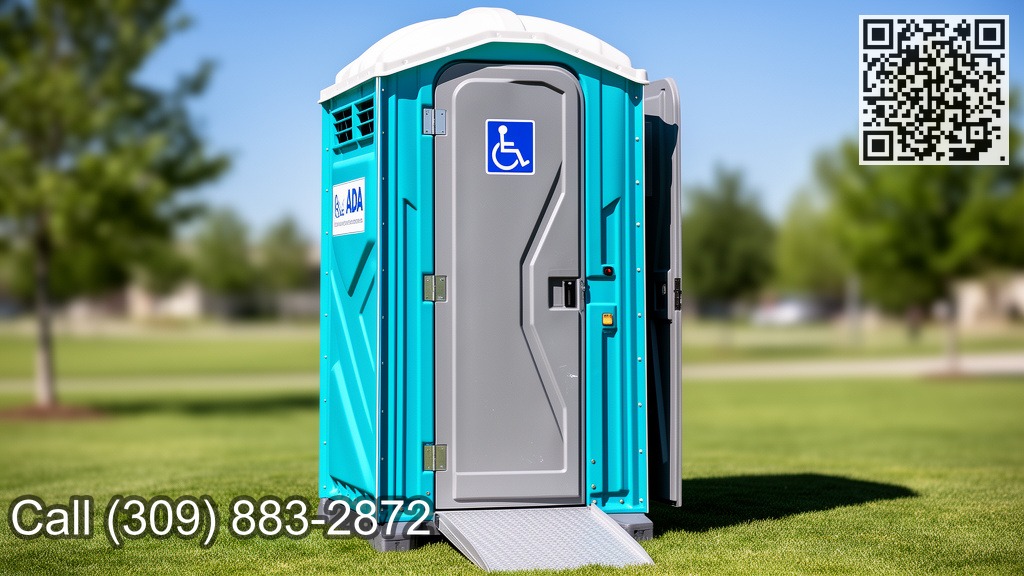
A certified matter can still create a poor outcome if the available device is properly unusable. The government criteria call for more than a larger stall or a wider door. An ada certified available portable bathroom should be found on an available course, and the entrance has to be accessible as well. If ramps or landings are needed, those components need to abide by the technical requirements.
Inside the system, the bathroom area have to meet the relevant technological requirements for fixture clearances, transforming space, door steering clearances, and the relevant grab bar and water storage room clearance guidelines. The unit additionally needs to be identified with the International Sign of Accessibility.
That is why I have a tendency to inform customers that buying an ada mobile commode is the start of conformity, not the end of it. The rented system has to operate as part of an accessible experience from the technique right through use the restroom.
A common planning mistake is to put the available unit on soft ground, loose crushed rock, or a path broken by inclines, aesthetics, cables, pipes, fencing, or short-lived storage. An additional is to tuck the available system off to the side since it is bigger and more challenging to suit the row. Even if the rental firm provides the correct ada handicap accessible portable restroom, the website setup can still weaken accessibility.
What "5 percent" resembles in actual life
The criteria provide the percentage demand, which is the regulating policy. In everyday planning, people often want a fast means to consider it. If the cluster is tiny, you still need to make sure the obtainable need is satisfied within that group of devices. If the collection gets bigger, the number of needed available systems rises with it.
What issues most is that you do not deal with the percent casually. A collection of portable toilets is not excluded even if it is short-lived, and a festival is not excluded just because everybody is moving fast. Momentary events are particularly part of the conversation here.
I would certainly beware concerning making up your own rounding technique unless your lawful advise or authority having actually territory has given direction. The validated government guideline below is the 5 percent minimum in each cluster. If your matter lands in a gray area and you doubt exactly how to apply it, the useful and gentle reaction is straightforward: do not cut it close. Order sufficient ada certified portable commodes to clearly please the demand and ensure they are correctly placed.
That approach often tends to avoid 2 frustrations simultaneously. Initially, it lowers the threat of underproviding accessible devices. Second, it normally boosts the guest experience for people that require more room, easier entry, and usable clearances.
Temporary does not imply exempt
This factor is worthy of ordinary language because it still shocks people. The easily accessible device demand uses also at short-term events. That implies performances, fairs, short-term community occasions, and similar rental situations are not outside the reach of access policies just because the setup only lasts a day or a weekend.
The functional effect is that a portable toilet rental plan requires the very same technique you would offer a much more irreversible center. If you are mapping outdoors tents, phases, secure fencing, food locations, and car parking, the ada mobile commode rental part ought to become part of that website discussion early, not something managed the mid-day prior to delivery.
I have actually watched event groups invest hours talking about generator positioning and group circulation, then deal with toilet availability like a final upgrade. It is much easier to get this right when the easily accessible course and unit placement are prepared prior to vehicles arrive.
The construction-site exception individuals misunderstand
There is an important exception in the older 1991 standard language that usually obtains repeated without context. Portable toilet systems at building and construction sites utilized solely by building and construction employees were discriminated under that earlier scoping provision.
What matters for a lot of viewers is this: that exemption does not get rid of the accessible-unit need for general portable bathroom rentals. If you are preparing mobile washrooms for the general public or for a mixed-use setting, you must not presume that a construction-related carveout relates to you.
This is one of those areas where partial expertise creates troubles. Someone hears that building mobile commodes are discriminated and after that presumes all temporary devices are outside the ease of access guidelines. That is not a safe assumption. For basic rental clusters, the accessible-unit requirement remains.
The difference between a larger system and an accessible one
Not every bigger mobile bathroom is instantly an ada certified portable bathroom. Dimension assists, yet dimension alone is not the standard.
For a mobile system to work as the required easily accessible choice, it has to meet the applicable technological demands for commode spaces. That includes turning area, door steering clearances, fixture clearances, and the appropriate grab bar and water wardrobe clearance regulations. It additionally needs accessible approach and entrance. In addition to that, it has to be related to the International Symbol of Accessibility.
This is where specific language issues when you talk to a rental carrier. If you simply request for a "large unit," you might not obtain an ada certified portable toilet. If you ask particularly for an ada accessible mobile bathroom and validate that it is meant to please ADA ease of access demands, the discussion gets much clearer.
I also recommend staying clear of shorthand that leaves excessive area for analysis. Terms like "mobility device unit" or "handicap system" occasionally obtain utilized freely in the field. If you need conformity, say so directly. Ask for ada certified easily accessible mobile restrooms, and after that confirm how they will be mounted and identified on site.
Placement can make or damage compliance
An available portable washroom ought to not really feel like a special detour. It needs to be incorporated right into the cluster in such a way that a person can actually make use of without unnecessary barriers.
That indicates considering the course initially. If the accessible device is divided by mud, ruts, curbs, steep short-term transitions, or obstructed passages, the accessible tag does not do a lot great. The route and entryway require to be obtainable, and any type of ramps or landings that are required should comply with the technical requirements.
Then think about the door and the immediate area around it. Door steering clearances belong to the technological needs for the toilet room. In useful terms, crowding the device with barricades, wastebasket, water barrels, or piled materials is a negative practice. I have seen arrangements where the unit itself was most likely appropriate, but the area in front of the door had been ingested by event equipment by opening up time.
Inside the device, transforming room and fixture clearances are not optional information. They are the reason an easily accessible device is various from a basic one. Anybody that has actually tried to navigate a confined temporary toilet understands that a couple of inches in the incorrect location can turn a nominally accessible device right into an aggravating one.
A helpful means to assess a rental cluster before opening
The most convenient time to take care of an availability problem is prior to guests or attendees get here. Once lines kind and the site is energetic, moving units or reconstructing gain access to is much harder.
Here is the evaluation I like to see prior to sign-off:
- Confirm that each cluster of portable single-user units consists of a minimum of 5 percent easily accessible units.
- Check that every required ada mobile bathroom is marked with the International Icon of Accessibility.
- Walk the course per easily accessible system and see to it the entrance is really accessible.
- Verify that any type of ramps or touchdowns supplied as part of the setup comply with ADA technical requirements.
- Make sure the device is not blocked which the needed inside functionality has not been endangered by configuration shortcuts.
That might appear standard, however most expensive blunders in this field are fundamental mistakes. Someone purchased the ideal unit and put it in the incorrect place. Someone booked an ada mobile commode, yet a delivery team changed the format to make room for a fencing line. Someone thought the rental firm managed all ADA details, while the occasion group assumed the exact same in reverse.
What customers generally ask after they listen to the 5 percent rule
Once people recognize that a minimum of 5 percent of each cluster must come, the next inquiries are almost always functional. Is one unit sufficient? Do we require more than the minimum? What happens if the site is spread out out?
The government criterion in the validated context gives the minimal percentage for each cluster. Beyond that, judgment issues. If your website has a number of different restroom banks, think in terms of real traveling patterns, not simply arithmetic. A solitary ada portable toilet in one distant edge might technically please one cluster but still offer individuals poorly if the occasion footprint is huge and activity in between locations is difficult.
There is also a human truth that does not always show up in formulas. Accessible units are commonly used by people that require more room for wheelchair devices, assistance, or handling, however they may likewise be looked for by various other visitors simply due to the fact that the device feels roomier. That is one factor coordinators sometimes determine to go beyond the bare minimum, specifically at active public events. I can not inform you a global number beyond the validated federal minimum, but I can claim that making to the minimum only functions well when the remainder of the configuration is thoughtful.
If you anticipate rush hour, separated activity zones, or long dwell times, a thin compliance approach can create actual stress for customers that depend on the accessible units.
Accessibility becomes part of a broader conformity culture
There is a larger background worth observing. ADA compliance is not obtaining lesser or much less visible. Enforcement and advice activity throughout fields proceeds, and accessibility expectations are significantly component of just how organizations are evaluated, both lawfully and publicly.
That does not change the technological rule for mobile bathroom collections, which remains the 5 percent obtainable minimum in each cluster, along with the path, entry, identification, and toilet-room demands currently discussed. What it transforms is the knowledge of treating these commitments casually. The days when a location can think nobody would certainly look very closely are fading.
For occasion organizers and site managers, that suggests the accessible bathroom strategy must be documented, inspected, and collaborated with the rental provider rather than dealt with informally.
The inquiries worth asking your rental company
An unusual amount of problem can be stayed clear of by asking better inquiries prior to delivery. Not every company utilizes the exact same terms, and not every sales conversation normally enters technological details unless you push for them.
The most beneficial inquiries are simple. Ask whether the device being recommended is an ada certified portable toilet intended to satisfy ease of access demands. Ask the number of available units are being appointed to each collection. Ask just how the units will be recognized. Ask what the carrier anticipates from the website in order to keep an accessible route and entryway. If ramps or touchdowns become part of the arrangement, ask that is in charge of making certain those aspects comply.
You do not require to turn the call into a lawful seminar. You simply require clearness. A great deal of customers presume "easily accessible" is self-explanatory, however on a jampacked project, assumptions are where mistakes live.
The safest mindset
The most safe way of thinking is to think of the obtainable mobile bathroom as component of the core restroom plan, not as an add-on for optics. As soon as you do that, the planning enhances. The system gets placed where people can reach it. The course obtains examined prior to opening. The symbol shows up. The collection matter makes sense. The setup offers real individuals rather than pleasing an obscure checklist.
So, how many ada compliant portable restrooms are called for in a rental cluster?
At the very least 5 percent of the mobile single-user systems in each cluster must come. Those systems need to be related to the International Symbol of Access, and they must be set up in a manner that gives an easily accessible route, an available entryway, and compliance with the suitable toilet-room technological demands, including transforming room, door maneuvering clearances, fixture clearances, and the relevant grab bar and water closet clearance rules.
That is the legal center of the solution. The useful facility is equally as crucial: if a person can not reach it, enter it, turn inside it, and use it with dignity, the job is not done.
 Ask ChatGPT
 Ask Grok
 Ask Perplexity
 Ask Claude
 Ask Google AI
 Ask You
Corrections
Spot something wrong? Send it to the desk and it gets fixed in the open.